How Big is Jupiter Compared to Earth? A Complete Size Comparison
Understanding the scale of our solar system can be mind-bending, especially when comparing Earth to Jupiter, the gas giant that dominates our planetary neighborhood. Jupiter isn’t just bigger than Earth—it’s incomprehensibly massive. If you’ve ever wondered about the actual dimensions and what those numbers mean in practical terms, this comprehensive guide breaks down the Jupiter versus Earth comparison in ways that make sense.
Whether you’re a science enthusiast, a student researching planetary science, or simply curious about our place in the cosmos, grasping Jupiter’s true size relative to Earth fundamentally changes how you perceive space. This comparison reveals not just numbers, but the vast differences in mass, volume, and the physical forces that shape these two completely different worlds.

Jupiter’s Diameter: The Basic Numbers
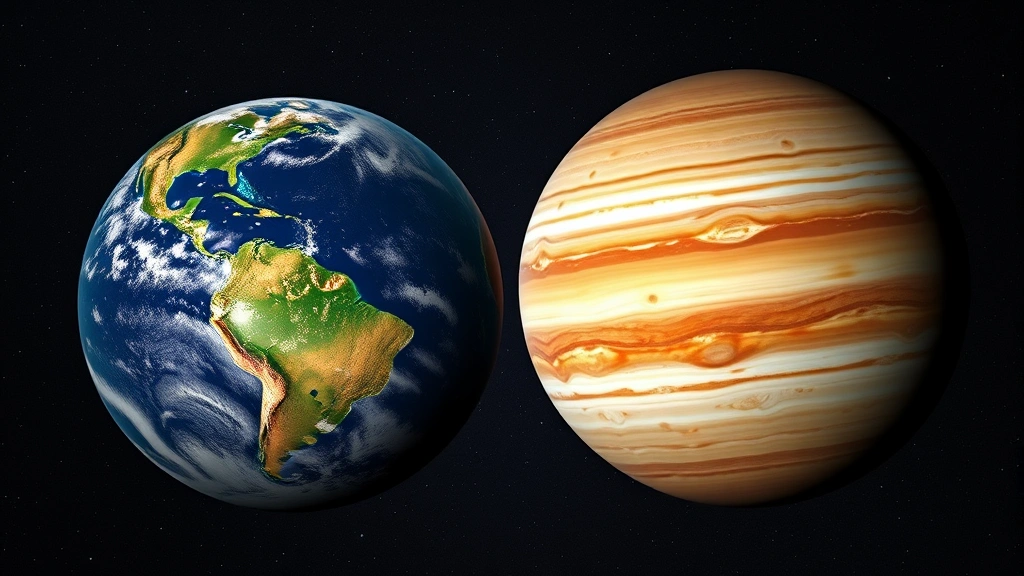
The most straightforward way to compare Jupiter and Earth starts with diameter measurements. Earth has a diameter of approximately 12,742 kilometers (7,926 miles) at its equator. Jupiter, by contrast, measures roughly 142,984 kilometers (88,846 miles) in diameter. This means Jupiter is approximately 11.2 times wider than Earth—more than eleven times the width of our entire planet.
To put this in perspective, you could line up over eleven Earths side by side across Jupiter’s equator. This single measurement begins to illustrate just how enormous the gas giant truly is. The diameter difference alone demonstrates why Jupiter has dominated our solar system since its formation, and why understanding planetary science helps us appreciate our world’s place in the cosmos.
These measurements come from observations by space agencies including NASA and the European Space Agency. The precision of modern astronomical instruments allows scientists to measure planetary diameters to within a few kilometers, making these comparisons highly accurate for educational and scientific purposes.
Volume Comparison: How Much Space Each Planet Occupies
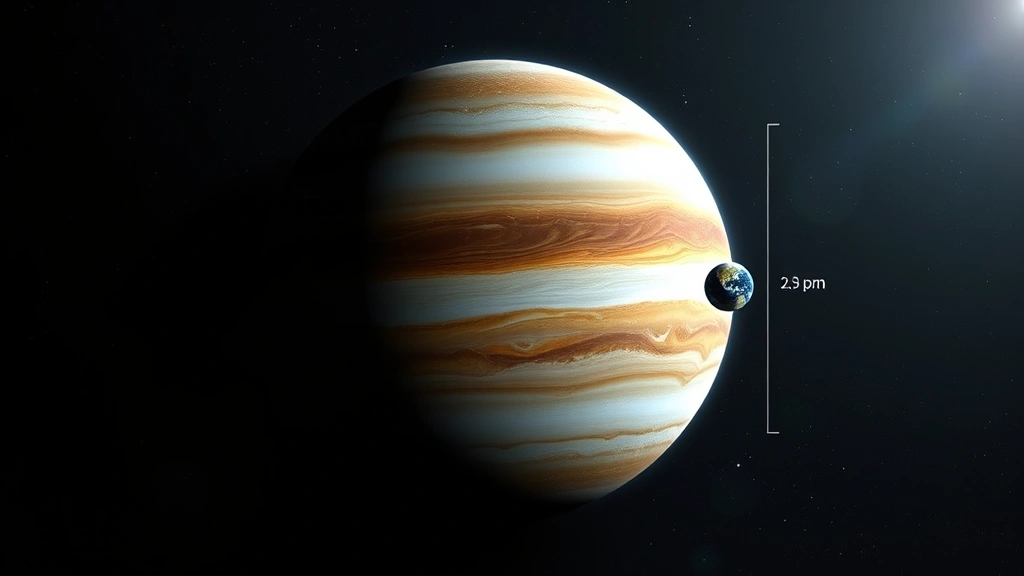
Diameter alone doesn’t tell the complete story. When you account for three-dimensional volume, the difference between Jupiter and Earth becomes exponentially more dramatic. Earth’s volume is approximately 1.08 trillion cubic kilometers. Jupiter’s volume reaches approximately 1.43 quintillion cubic kilometers—that’s 1.43 followed by eighteen zeros.
In practical terms, Jupiter could fit approximately 1,321 Earths inside it. Imagine filling Earth with over thirteen hundred complete copies of our planet, and you’d still have room inside Jupiter. This volumetric difference fundamentally explains why Jupiter is classified as a gas giant rather than a terrestrial planet like Earth.
The volume calculation uses the formula for spherical volume (4/3πr³), where radius measurements are squared and cubed, which magnifies the size difference exponentially. This is why relatively modest diameter differences translate into absolutely staggering volume disparities. When you’re working with spheres, small changes in radius create massive changes in total volume.
This principle applies to many construction and engineering contexts as well. When planning basement finishing projects or calculating material volumes, understanding how three-dimensional measurements scale becomes practically important for accurate planning and budgeting.
Mass and Weight Differences
Size doesn’t always correlate directly with mass, but in Jupiter’s case, both measurements are staggering. Earth’s mass is approximately 5.97 sextillion kilograms (5.97 × 10²⁴ kg). Jupiter’s mass is approximately 1.898 septillion kilograms (1.898 × 10²⁷ kg). This means Jupiter is roughly 318 times more massive than Earth.
The mass difference is less dramatic than the volume difference because Jupiter is composed primarily of hydrogen and helium gases, which are far less dense than Earth’s rocky composition. Earth’s average density is 5.52 grams per cubic centimeter, while Jupiter’s average density is only 1.24 grams per cubic centimeter. Despite being a gas giant, Jupiter’s enormous size makes its total mass overwhelmingly greater.
This mass difference has profound gravitational implications. Jupiter’s gravitational pull is so strong that it has 318 times more gravitational influence than Earth. If you weigh 100 pounds on Earth, you’d weigh approximately 236 pounds on Jupiter’s cloud-top surface (accounting for Jupiter’s slightly smaller radius partially offsetting the mass advantage). No human could stand on Jupiter’s surface because there is no solid surface—Jupiter has only clouds and interior layers of increasingly dense gases and liquids.
Understanding mass and gravitational relationships helps explain why structural engineering and load-bearing calculations matter for home projects, where gravity’s effects directly impact safety and stability.
Atmospheric Composition and Structure
Jupiter and Earth have completely different atmospheric compositions, reflecting their distinct evolutionary histories and positions in the solar system. Earth’s atmosphere is primarily nitrogen (78%) and oxygen (21%), with trace amounts of argon, carbon dioxide, and other gases. This composition supports life as we know it.
Jupiter’s atmosphere consists primarily of hydrogen (about 75%) and helium (about 24%), with trace amounts of methane, ammonia, hydrogen sulfide, and other compounds. These trace gases create Jupiter’s distinctive colored bands and storm systems. The famous Great Red Spot is a storm system larger than Earth that has persisted for at least 350 years.
Jupiter’s atmospheric pressure at the cloud tops is roughly 1 bar, similar to Earth’s sea-level pressure. However, as you descend into Jupiter’s atmosphere, pressure increases dramatically. The atmosphere transitions gradually from gas to liquid hydrogen as depth increases, eventually reaching a core region of potentially rocky material under extreme pressure and temperature conditions.
Earth’s atmosphere, by contrast, becomes progressively thinner with altitude. The boundary between atmosphere and space occurs around 100 kilometers altitude, while Jupiter’s atmosphere extends thousands of kilometers deep before transitioning to different states of matter.
What These Differences Mean for Life
The fundamental differences between Jupiter and Earth make one habitable and the other completely uninhabitable for any known form of life. Earth’s moderate size, distance from the Sun, solid surface, and atmospheric composition create conditions where water remains liquid and complex chemistry can support biological processes.
Jupiter’s extreme conditions—crushing atmospheric pressure, lack of solid surface, frigid temperatures (average temperature around -110°C or -166°F at cloud tops), and intense radiation from the Sun at its distance—make it impossible for life as we understand it to exist. No spacecraft could survive Jupiter’s environment, and no human could venture there without extraordinary protective measures.
However, some of Jupiter’s moons present more interesting possibilities. Europa, with its subsurface ocean beneath an ice crust, is considered one of the most promising locations in our solar system for potential microbial life. Io, Ganymede, and Callisto each present unique characteristics worth scientific study. This demonstrates how Jupiter’s massive gravitational influence shapes an entire system of moons with varied properties.
The habitability differences between Earth and Jupiter underscore why our planet is so precious and why creating safe, stable living spaces on Earth requires understanding construction principles that protect us from the elements.
Visual Perspective: Imagining the Scale
Numbers alone struggle to convey the true scale difference between Earth and Jupiter. Visual comparisons help bridge this gap. Imagine Earth as a standard marble—about 2 centimeters in diameter. At this scale, Jupiter would be approximately 23 centimeters in diameter, roughly the size of a cantaloupe or small basketball.
Now imagine a model of the solar system. If Earth were marble-sized and positioned at one location, Jupiter would need to be positioned 5.2 times farther from the Sun, at the scale model distance representing 778 million kilometers. The Sun itself, at this scale, would be roughly 2 meters in diameter—far larger than any planet.
These scale models help illustrate why the solar system is so vast and why planets, despite their enormous sizes, are relatively tiny compared to the distances separating them. If you could shrink yourself to marble size and somehow survive, traveling from Earth to Jupiter would require crossing an enormous void of empty space.
Professional visualizations and planetarium shows often use similar scaling techniques to help audiences grasp cosmic distances and sizes. NASA and other space agencies regularly produce materials comparing planetary sizes to familiar objects, making abstract astronomical concepts more concrete.
How Jupiter Compares to Other Planets
Jupiter dominates our solar system, but understanding how it compares to other planets provides additional perspective. Saturn, the second-largest planet, has a diameter of about 120,536 kilometers—significantly smaller than Jupiter but still vastly larger than Earth. Saturn would fit roughly 764 Earths inside it.
Uranus and Neptune are also gas giants, though smaller than Jupiter. Uranus has a diameter of approximately 50,724 kilometers and Neptune about 49,244 kilometers. All four gas giants dwarf the terrestrial planets—Mercury, Venus, Earth, and Mars.
Mercury, the smallest planet, has a diameter of only 4,879 kilometers—less than 40% of Earth’s diameter. Mars, often compared to Earth because of its potential habitability, measures roughly 6,779 kilometers in diameter—only about 53% of Earth’s size. These comparisons show that Earth, while modest compared to the gas giants, is actually the largest terrestrial planet in our solar system.
Jupiter’s dominance extends beyond size. Its gravitational influence shapes the entire solar system. The planet’s massive gravity well affects asteroid trajectories, influences comet paths, and may have played a crucial role in planetary formation billions of years ago. Some scientists theorize that Jupiter’s migration during the early solar system significantly influenced where other planets formed.
This cosmic perspective, while focused on astronomy rather than Earth-based construction, reminds us why building and creating on Earth requires understanding the forces and materials we work with—our planet’s gravity, atmosphere, and materials are what we must work within.
FAQ
How many Earths fit inside Jupiter?
Approximately 1,321 complete Earths could fit inside Jupiter’s volume. This calculation uses the volumetric formula for spheres, accounting for Jupiter’s diameter being about 11.2 times Earth’s diameter. The cubic relationship between radius and volume creates this dramatically large number.
Is Jupiter the largest planet in the solar system?
Yes, Jupiter is definitively the largest planet in our solar system. No other planet comes close to its size. Jupiter is more than twice the mass of all other planets combined, making it the dominant planetary body in our solar system after the Sun.
Could humans survive on Jupiter?
Humans could not survive on Jupiter under any realistic circumstances. There is no solid surface to stand on, atmospheric pressure would crush any spacecraft, temperatures are frigid, and the radiation environment is hostile. Jupiter exists in a completely different category of environment than Earth.
Why is Jupiter so much larger than Earth?
Jupiter’s larger size results from its formation in the outer solar system where gravitational conditions allowed it to accumulate vast quantities of hydrogen and helium during the solar system’s early development. Earth, forming closer to the Sun, experienced different conditions that resulted in a rocky, terrestrial planet.
How long would it take to travel from Earth to Jupiter?
The distance varies depending on planetary positions, ranging from about 550 million kilometers at closest approach to over 900 million kilometers at maximum distance. Space probes typically take 1-6 years to reach Jupiter depending on trajectory and launch timing. Human spacecraft, with current technology, would require several years for a one-way journey.
Does Jupiter have any solid surface?
Jupiter likely has a solid or liquid core deep within its interior, but there is no accessible solid surface. The planet consists of layers of increasingly dense gases and liquids. The “surface” we observe is actually the top of the visible cloud layer.
How does Jupiter’s gravity compare to Earth’s?
Jupiter’s surface gravity (measured at cloud tops) is approximately 2.36 times stronger than Earth’s. This means you’d weigh 2.36 times more on Jupiter than on Earth. However, this is less dramatic than the mass difference because Jupiter’s radius is also much larger, and gravity decreases with distance from the center.


